Many people have wrote that there is no such thing as altruism. I must admit that I have also always thought the same thing..even though I continued to search for one such act. I have often been the lone arguer pointing out that no one has been able to uncover a single example of true altruism...in a natural setting or in the human race. I am now rescinding my previous statement. I have for a very long time..searched for an example that I could in some way attribute to altruism..and until now I have been unsuccessful. I suppose all examples are based upon your own definition of altruism. I learned many years ago that altruism is an act done by an individual at a cost..benefiting another individual not of relation to the one performing the act.
The said example concerns a chimpanzee and a human. A researcher was following a group of chimpanzees in the jungle. After some hours, he found that he had forgotten his lunch back at the research station. This researcher then proceeded to try to knock down fruit from a tree some distance from where the group of chimpanzees sat eating their mid-day meal. It has been noted that after some time of unsuccessful attempts to acquire fruit... a young male from the group collected some fruits from a tree and climbed down toward the researcher. The chimpanzee then proceeded to approach the researcher and leave the fruit for the researcher.
This instance has been noted as a true act of altruism by any definition since the chimpanzee was not of relation to the researcher (not in the last 1000 years at least) and this act was a cost to itself with no benefit. Therefore, I stand corrected on the notion of altruism...it seems to exist after all.
References
Compassion, Rescue and the Altruism Debate, The emotional lives of animals Jeffrey Moussaieff Masson and Susan McCarthy.
Showing posts with label Behavior. Show all posts
Showing posts with label Behavior. Show all posts
Saturday, December 23, 2006


Tuesday, December 19, 2006
Why We Should Always Question..

There are many moments in time that we look back at now...which will always lead to us to slap our foreheads and say, "stupid, stupid, stupid". There is one such moment that continues to be brought up in the most general science classes..as if to say.."if you don't test and retest...we will ridicule you for years to come". This example is of course the lemming. Lemmings were believed to commit, "The Lemming Suicide Plunge" when the population became too numerous. It was really believed that millions of lemmings would be overcome by a hard-wired impulse to dash to their death by hurling themselves over a cliff to the rocks below or by plunging into the sea to die a horrible death by drowning. The reasoning behind this was thought to be a deep-rooted act of altruistic behavior resulting the greater good for the species. However, you can probably guess, this is not the case. Shown to the right is a famous Far Side cartoon dipicting natural selection in action. As the lemmings dash to their death..there is one cheater in the group that will survive and ultimately passing on the cheater genes to future generations.
How this story may have gotten started....
Many rodent species experience very strange cyclic population explosions. It is very interesting that lemmings have one of the most regular cyclic fluctuations in population densities. It has been shown that these little creatures have population explosions about every three or four years. The population numbers of lemmings explode to high numbers, and then drop almost to extinction. Even after approximately 75 years of intense research, scientists do not fully understand why the populations fluctuate so much. Throughout the years, many factors have been tested (i.e., changes in food availability, climate, density of predators, stress of overcrowding, infectious diseases, snow conditions, sunspots, etc) but none completely explain why populations of lemmings have these explosive cycles.
The myth of the lemming most likely started when these population explosions happen and the lemmings migrate away from areas with a dense population. As you can imagine, the migrations begin slowly and erratically. It has been shown that small numbers of lemmings will move at night, and larger groups in the daytime. This movement causes small groupings of lemmings to move instead of one continous mass, usually seperated by a short time frame of 10 minutes or so. It has been noted that they will often follow well worn paths and roads along their journey.
As you can imagine, there will be unavoidable obstacles, such as streams and lakes inevitalby causing them to swim as a last resort. Suprisingly, they are able to swim across a 200 meter body of water on a calm night, but most will drown in a windy night.
So why the myth began....
It is due to a very unlikely source....Walt Disney. Walt Disney was making a movie tittled, "Wild Wilderness" which was released in 1958. It was filmed in Alberta, Canada, in a location that is far from the sea and not a native home to lemmings. The lemming were imported and forced to jump to thier deaths by placing them on a spinning turntable that was covered with snow, and then shooting it from many different angles. The cliff-death-plunge sequence was done by herding the lemmings over a small cliff into a river. It's easy to understand why the filmmakers did this - wild animals are notoriously uncooperative, and a migration-of-doom followed by a cliff-of-death sequence is far more dramatic to show than the lemmings' self-implemented population-density management plan.
The moral of the story....lemmings do not commit mass suicide and Walt Disney has clear prejudice against the lemming and for the mouse.
Monday, November 20, 2006
Fruitless Attempts To Explain Behaviour Hardwiring
About an year ago, Dickson lab had published an article about a behavioral switch gene, called Fruitless. It had gained notoriety in the popular press as the “Gay Gene” since it affects sexual orientation but to me Fruitless is interesting not only because it determines sexual orientation but more importantly as it gives a glimpse into how genes modulate behavior.
You see, behavior is “hard wired”into our nervous system during development. The neuronal body plan is already present in our genome - the developmental genes that direct cells to grow into a specific type or in a specific direction. These genes during development take cues from the environment and hard wire innate behavior in to a species. I have always thought that to be the coolest thing. Think about it - we are not only a function of our genes but also product of our environment. And Dickson's research links the two together - how a presence of a single gene product directs the function of neurons responsible for sexual orientation in fruit fly males. Courtship behaviour in D. melanogaster is invovles a series of well chorographed steps that invovle the visual, the olfactory, the tactile, the acoustic, the gustatory and the mechanosensory stimuli being exchanged between the sexes (See Fig.1). The role of the female is more simplified -she simply runs away, gives the odd kick, then mates (or not).
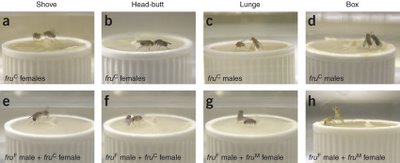 Figure 2. Aggresion Behavior in flies
You see, behavior is “hard wired”into our nervous system during development. The neuronal body plan is already present in our genome - the developmental genes that direct cells to grow into a specific type or in a specific direction. These genes during development take cues from the environment and hard wire innate behavior in to a species. I have always thought that to be the coolest thing. Think about it - we are not only a function of our genes but also product of our environment. And Dickson's research links the two together - how a presence of a single gene product directs the function of neurons responsible for sexual orientation in fruit fly males. Courtship behaviour in D. melanogaster is invovles a series of well chorographed steps that invovle the visual, the olfactory, the tactile, the acoustic, the gustatory and the mechanosensory stimuli being exchanged between the sexes (See Fig.1). The role of the female is more simplified -she simply runs away, gives the odd kick, then mates (or not).

Fig. 1 Courtship behaviour in Fruitfly
This normal courtship behaviour seems to be disrupted in the Fruitess mutants. Before we talk about what happens when we mutate this gene, lets us take a brief overview of what is known about the gene. Fruitless gene was molecularly cloned in 1996 and the putative protein encodes a transcription factor. Fruitless is sex specifically spliced - in lay man terms it means that males produce one version of this protein where as the females produce another. This sex specific splicing is regulated by presence or absence of another protein called Transformer, which in Drosophila also determines the sex in the fly.
So what happens if you produce the wrong version of the protein in either sexes? By forcing males to express the female-specific Fruitless transcript by using the awesome power of Fly genetics (:P), the Dickson Lab produced males that were sterile, uninterested in courting females, actively courting males, actually ending up forming courtship chains (see this). By contrast, females making the male version of the protein mated poorly, produced very few eggs, but — astonishingly — courted other females (see this), even to the point of forming chains.
So why does this happen? When you look at the the central nervous system of males and females ,there are very few differences in terms of sex-specific Fruitless expression- in number, position or wiring of cells that express this protein. But Fruitless is present in the olfactory sensory neurons which play an important role in fly courtship behavior. So when male fruit flies cannot produce this male specific form or produce a mutant form of this protein, you get males that court other males. In other words, a single gene encoded product is enought to shift the functioning of the nervous system from male to female mode, irrespective of the morphological sex of the animal. Simply put with mutant (rather non-sex specific)versions of the protein, flies change their sexual orientation but they not other aspects of their morphology.
Now the same gene is making a news splash again – the Kravitz lab has linked Fruitless to yet another sex-specific behavior – aggression/ fighting patterns. Aggression found in almost all animals - from sea anemones to human - helps to acquire food/shelter/ mates or defend the same. Despite its importance, relatively little is known of the neural and humoral mechanisms that are its proximate causes. Many behavioral patterns in aggressive behavior are shared in flies but there are a subset that are sex specific. Female fighting, for example, largely involves head butts and some shoving. Males show extended wing threats, wing-flicking while retreating, and high intensity components of fighting like boxing, tussling and holding. In contrast to male fighting behavior, no clear hierarchical relationship results from the interactions between female flies.
 Figure 2. Aggresion Behavior in flies
When the versions of Fruitless are swapped, the males fight like females (the sissies) and females lunge at their opponents as seen in the Figure 2 above. The top panel shows the normal aggresion patterns seen in males and females while the bottom panel shows what happens when the flies produce the wrong version of the protein. Panels e and f show males exhibiting female aggression pattern when they express the female version of the protein. When the sexes with the opppsite version of the protein are put together in the panel g and h. In panel g, the upright lunging fly is a female and so is the upright "boxing" fly in panel h , indicating that swapping the protien alters how the flies respond - another innate behaviour affected!
The question that still remains (the most important one) is what is the effector? What does Fruitless, a transcription factor, modulate in a gender specific manner to control the sex specific aspect of behaviour?
There is a lot to still uncover but we are finally beginning to glimpse at how a genes influence how we respond. I believe that most behaviour is hard wired but at the same time modulation of the behaviour is environmental dependant. And now we finally are beginning to tell the effect of nature on nurture. A fun time lies ahead in molecular neuroscience!
Reference
1 - Demir, E. & Dickson, B. J. Cell 125, 785−794 (2005).
2- Vrontou E, Nilsen, S. P., Demir, E., Kravitz, E. A. & Dickson, B. J. Nature Neuroscience - 9, 1469 - 1471 (2006)
Subscribe to:
Posts (Atom)
