Let there be light:
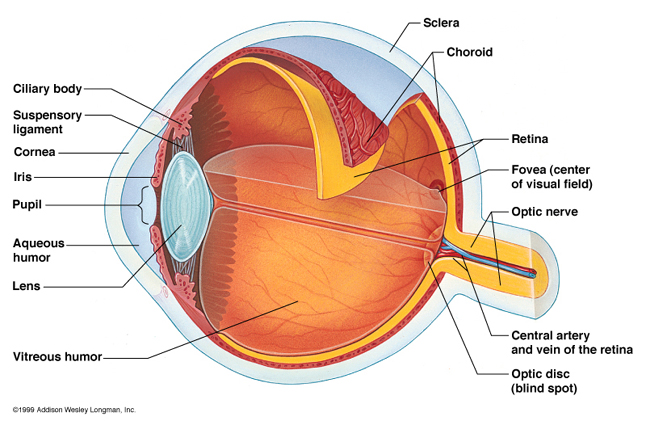
As we think about the basic parts of our eyes (Fig. 1), we observe that they consist of cornea, lens, iris, ciliary muscle, and retina connected by optic nerve to brain. Functioning of eye depends on the amount of light entering the eye (Light intensity) and focusing of the image on retina. Two independent systems control these two aspects of vision.
Firstly, amount of light is regulated by the opening of pupil which is controlled by the two muscle groups in iris. Sphincter (controlled by cranial circuit which also controls the ciliary muscles which help in focusing) and dilator muscles (controlled by symphathetic nervous system of spinal cord: I wonder whether this is the reason why people look for dilated pupils when looking for vital signs in an unconcious person). Dilator muscles causes the pupil to open more whereas sphincter muscles cause the pupil to close as they contract. Acting together they control the opening of pupil in such a way that there is always an optimum light intensity falling over retina. This is a feedback control system where the pupil opening is the controlled variable( via the sphincter and dilatory muscles) while the system output is the light intensity on retina. The input is the light intensity of the environment and the control system aims to achieve a perfect pupil opening that optimizes the light intensity on retina under varying environmental conditions. By testing the pupil opening with narrow light beams (so that they do not have an effect on the light intensity regardless of pupil opening and thus disconnecting this feedback loop) it was found that the system is a very stable low gain system. Further, it is to be noted that this is not the only way eye responds to light intensity. There is another system on retina itself which adjust the signals to the optic fiber based on light intensity (reason why we can see the outlines a little better in a dark room after a few seconds of adaptation).
For more information about eye: http://www.arn.org/docs/glicksman/eyw_041001.htm
How about a little warmth as well: Maintianing optimum body temperature is vital for survival as most of the enzyme catalyzed reactions rates depend critically on it. Temperatures of cold blooded animals follows that of its surroundings (poikilothermy; one of the reasons such animals can be found mostly in tropical and temperate regions of the world) while that of warm blooded animals is tightly regulated (of course allowing for diurnal variations based on circadian rhytms) and is known as homeothermy. However, not everything is in pure black and white as is the rule in nature. During hibernation warm blooded animals such as hedgehog, bat and dormouse become coldblooded (to conserve their energy?) and this is referred to as heterothermy.
(More info on mammalian temperature regulation here: http://animals.about.com/cs/mammals/a/aa061601a.htm and Wikipedia entry:
http://en.wikipedia.org/wiki/Body_temperature )
For more information about eye: http://www.arn.org/docs/glicksman/eyw_041001.htm
How about a little warmth as well: Maintianing optimum body temperature is vital for survival as most of the enzyme catalyzed reactions rates depend critically on it. Temperatures of cold blooded animals follows that of its surroundings (poikilothermy; one of the reasons such animals can be found mostly in tropical and temperate regions of the world) while that of warm blooded animals is tightly regulated (of course allowing for diurnal variations based on circadian rhytms) and is known as homeothermy. However, not everything is in pure black and white as is the rule in nature. During hibernation warm blooded animals such as hedgehog, bat and dormouse become coldblooded (to conserve their energy?) and this is referred to as heterothermy.
(More info on mammalian temperature regulation here: http://animals.about.com/cs/mammals/a/aa061601a.htm and Wikipedia entry:
http://en.wikipedia.org/wiki/Body_temperature )
It can be observed that for the thermoregulation system: the controlled variable is the heat producing/conserving mechanism while the output is body temperature. The input variable is the environment temperature and the temperature of the body. Now one can ask, where should be temperature be measured so that it best represents the body temperature? on the surface of the body? or closer to the internal organs? As anyone would point out, skin temperature is not the best place to estimate the body temperature, just as placing the thermometers on the outside of a building whose interior temperature has to adjusted is a bad idea. However, it is always a good idea to open/close the windows based on outside temperature while firing up the heater must be based on both outside and inside temperature. Something similar happens in our bodies too....the internal mechanism activates the heat producing/ conserving mechanism; while the case of conserving heat by closing windows regardless of inside temperature can be related to closure of sweat glands in cold weather regardless of internal temperature. This way the amount of energy expended to maintain the temperature can also be minimized. more often than not, such multiple optimization schemes are inbuilt in biological control systems.
Ref: Optimality principles in biology: Robert Rosen, Butterworths, London. 1967. [An Excellent book that deals with the issues we discussed in chapter 9]
In the next article, we hope to discuss how seemingly extremely complex branching pattern of blood circulation system can be derived from optimality arguments (again the above book has an excellent analysis).
In the next article, we hope to discuss how seemingly extremely complex branching pattern of blood circulation system can be derived from optimality arguments (again the above book has an excellent analysis).


