It was not too long back that the whole of biology was very protein and DNA centric. The reasoning was that proteins were used to do all the work in the cell - be it chemical work (enzymes), or physical work (motors, and pumps). DNA was important because it provided all the information to make the proteins and contain the set of genetic instructions that are passed on from generation to generation. For long, there was a battle whether DNA was more important or proteins were more important neglecting DNA's chemical cousin RNA.
RNA was considered as a step required in modern organisms to convert DNA to proteins. RNA is made up of nearly the same chemical constituents as DNA but it is more flexible and can have wide ranging 3 dimensional structures unlike DNA's double helical structure. However, this increased flexibility comes at a price - RNA is more unstable and in modern cells, a single molecule of RNA does not remain functional for long periods of time (mean life time is approx 5 minutes in E.coli).
Of course, all this changed when it was found that RNA molecules could be used as catalysts and even in modern day cells, there are some RNA catalysts also called ribozymes (and the list of ribozymes discovered keeps increasing). RNA captivated the imagination of biologists as this was a molecule that could store genetic information as well as be used as catalysts - taking on the dual role of enzymes and information storage. All of a sudden, RNA was considered to be at the origin of life as we know it. However in the RNA world hypothesis, one should take into consideration that it is not that only RNA is present. It only postulates that RNA is present and is dominant but other biochemicals such as peptides (small proteins) and DNA oligomers (small DNA molecules) are also present and aiding life (idea originally proposed in [1]).
One of the biggest controversies against the RNA world hypothesis has been that it does not play that big a role in modern cells. However, it has been found more recently that there are many RNA control elements in the cell. One such control element is the riboswitch. For a gene to be made, the DNA gets converted into a message called the mRNA (messenger RNA) which later gets converted to the protein equivalent to that message. It has increasingly been found that mRNA do not contain only the message to be read but certain control elements could also be present in the mRNA. These control elements are called riboswitch.
Lets take an example. Supposing you want to make Vitamin B1. There is an intermediate in its biochemical pathway called thiamine pyrophosphate (TPP). TPP is also important for nucleotide (the chemical constituent of RNA and DNA) and amino acid (the chemical constituent of proteins) biosynthesis and is important for the cell to have the right amount of TPP channeled into the different biochemical pathways. When too much of TPP is present in the cell, TPP binds to a certain riboswitch in it's own biochemical pathway. This causes the riboswitch [2] to suddenly have a defined 3-dimensional structure (from an earlier random or semi structured RNA element). This defined 3-dimensional structure also blocks the production of the protein for making more TPP. The switch in the mRNA turns the production of the protein that makes TPP on or off depending on whether enough TPP is present in the cell or not - hence regulating the production of TPP itself. So far, riboswitches are found more in the microbial world and are only now being found in the eukaryotic world.
Now, in the latest issue of Nature, the first riboswitch that controls splicing in higher organisms such as fungus has been found [3]. Splicing is the mechanism by which parts of the mRNA are removed before the protein is made so that parts of the DNA never translated in the protein. Alternative splicing is the mechanism by which a single gene at the DNA level can be translated into multiple protein molecules. This is done by excising different parts of the mRNA (excising the DNA only in one situation and not another) before it gets converted to protein. Splicing and alternative splicing occurs only in eukaryotes and has also been discussed here.
Anyways, the first riboswitch in the mRNA have been found to function for alternative splicing purposes. The TPP biochemical pathway discussed above is the system that they found riboswitches in. In this case, when TPP was present, the riboswitch forms a three dimensional structure that avoids splicing and the protein that is formed can not make more TPP. So the objective was again control of TPP concentration in the cell but the means used was alternative splicing instead of just blocking formation of protein. The implications of these results will only come out with time, but there is speculation that this opens up a whole pandora's box on riboswitches that could be found in eukaryotes.
[1] The Genetic Code - Carl Woese, 1968.
[2] Thiamine derivatives bind messenger RNAs directly to regulate bacterial gene expression. Wade Winkler Ali Nahvi & Ronald R. Breaker. Nature 419, 952 - 956 (2002).
[3] Control of alternative RNA splicing and gene expression by eukaryotic riboswitches. Ming T. Cheah, Andreas Wachter, Narasimhan Sudarsan & Ronald R. Breaker. Nature 447:497 (2007) and its companion discussion article - Molecular biology: RNA in control. Benjamin J. Blencowe & May Khanna. 447:391 (2007)
pdf of all cited aritcles avaiable on request
Showing posts with label RNA splicing. Show all posts
Showing posts with label RNA splicing. Show all posts
Thursday, May 24, 2007


Wednesday, October 25, 2006
A Splicing Primer
The central dogma of molecular biology DNA-> RNA-> Protein shows the direction of flow of information of how the cells use the information stored in our DNA to make the necessary proteins. But the situation in most eukaryotes is a little more complex than that simple statement. In most eukaryotes, a gene sequence in a DNA is interrupted by non- coding information. Hence to make a protein, a cell first has to transcribe the gene (make a RNA copy of the gene, called pre-mRNA) and then modify the pre-mRNA by removing the non-coding sequence (intron) and joining the coding sequences (exons) together. The modified mRNA is then exported from the nucleus (where it was made) to the cytoplasm where the ribosome uses it as a template to make the protein. In simple English, the gene for making a proteinA looks like this "HEREabhjhdyfrhUSEndcbldfhdfmMEd ldshhglgmcFORdbfhdflhfnmc PROTEIN A". The task of the cells is to remove the gibberish and make a readable text out of the given instruction - HERE USE ME FOR PROTEINA. The cells then send this information to the ribosome (the protein factory) to make the protein.
Pre-mRNA splicing is the process in which the intronic sequences are removed within a large RNA-protein complex called spliceosome.
Why is splicing important? A spliceosme can remove the non-coding introns present in a given transcript varying combination in response to cellular cues, a process called alternative splicing. The recent completion of a draft of the human genome indicated that more than 59% of the human genes seem to be alternatively spliced (Hastings and Krainer,2001) and thus we can have more complexity (make a larger number of proteins) without increasing the number of genes present. For eg, the Dscam gene in flies has 38,000 alternatively spliced isoforms from four variable exon clusters!
More importantly, it is estimated that aberrant splicing causes about 15% of genetic diseases in humans (Philips and Cooper,2000). Thus, the spliceosome plays a critical role in generating the right template for making a protein and any abnormality in this process would be deleterious to the organism.
What do we know about this process? From genetic and biochemical experiments in the humble budding yeast, scientist have been able to understand how this process occurs. Because both the mechanism of splicing and the splicing machinery are highly conserved throughout eukaryotes, knowledge of yeast splicing gives us insights into the basic process in humans.
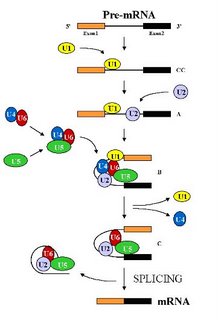 The spliceosome is the largest structure in the cell and is composed of five small nuclear RNAs ( called U1, U2, U4, U5 and U6 snRNAs) and over 100 different proteins (Stevens and Abelson , 2002). Under standard in vitro (i.e. in a test tube) assay conditions, the spliceosome assembles in a step wise manner through the addition of the U1 -> U2-> U4/U6.U5 snRNP particles (the small nuclear RNA along with its associated proteins, represented by a colored blob in the picture) on the pre-mRNA (See Figure). This assembly is an expensive process for the cell as each step consumes energy. But it also allows the apparatus to check each step and hence allows for a greater control over the overall process. Remember, a single mistake here would result in a protein that either does not function or functions abnormally. That to a cell would be hazardous and hence the cells err on the side of caution. After the assembly of the spliceosome, it undergoes structural rearrangements, resulting in the loss of U1 and U4 snRNAs, to become catalytically active (Brow D. A, 2002). Then, it proceeds to remove the intron by two transesterification reactions.
 The resultant message is released from the spliceosome along with the intron. The spliced RNA is exported to the cytoplasm for translation into the protein and the intron degraded by enzymes in the cell. The spliceosome is disassembled and the components (proteins and the snRNAs) recycled for another round of splicing.
Though much is known about the overall process, there is no insights into what triggers the activation. What informs the spliceosome that everything is set in place and hence go ahead and splice? How does the cell control the ATP driven helicases that remodel the spliceosome at each step? Or what cues the cell about abnormal spliceosome and how does it take a stalled spliceosome apart?
Next time I will try and address the role splicing plays in Humans. How does a cell choose which exon to keep? How do DNA elements present in the gene (ISEs) affect choice of exon? Does the rate at which the transcript is made affect exon choice? So keep your eyes out for Splicing -part deux.
References -
Brow D. A, Annu Rev Genet., 2002, Jun 11; 36:333-60.
Hastings and Krainer, Curr Opin Cell Biol., 2001, Jun; 13(3):302-9
Philips and Cooper, Cell Mol Life Sci., 2000, Feb;57(2):235-49
Stevens and Abelson , Methods Enzymol. 2002;351:200-20.
Check this Animation
Subscribe to:
Posts (Atom)
