It was not too long back that the whole of biology was very protein and DNA centric. The reasoning was that proteins were used to do all the work in the cell - be it chemical work (enzymes), or physical work (motors, and pumps). DNA was important because it provided all the information to make the proteins and contain the set of genetic instructions that are passed on from generation to generation. For long, there was a battle whether DNA was more important or proteins were more important neglecting DNA's chemical cousin RNA.
RNA was considered as a step required in modern organisms to convert DNA to proteins. RNA is made up of nearly the same chemical constituents as DNA but it is more flexible and can have wide ranging 3 dimensional structures unlike DNA's double helical structure. However, this increased flexibility comes at a price - RNA is more unstable and in modern cells, a single molecule of RNA does not remain functional for long periods of time (mean life time is approx 5 minutes in E.coli).
Of course, all this changed when it was found that RNA molecules could be used as catalysts and even in modern day cells, there are some RNA catalysts also called ribozymes (and the list of ribozymes discovered keeps increasing). RNA captivated the imagination of biologists as this was a molecule that could store genetic information as well as be used as catalysts - taking on the dual role of enzymes and information storage. All of a sudden, RNA was considered to be at the origin of life as we know it. However in the RNA world hypothesis, one should take into consideration that it is not that only RNA is present. It only postulates that RNA is present and is dominant but other biochemicals such as peptides (small proteins) and DNA oligomers (small DNA molecules) are also present and aiding life (idea originally proposed in [1]).
One of the biggest controversies against the RNA world hypothesis has been that it does not play that big a role in modern cells. However, it has been found more recently that there are many RNA control elements in the cell. One such control element is the riboswitch. For a gene to be made, the DNA gets converted into a message called the mRNA (messenger RNA) which later gets converted to the protein equivalent to that message. It has increasingly been found that mRNA do not contain only the message to be read but certain control elements could also be present in the mRNA. These control elements are called riboswitch.
Lets take an example. Supposing you want to make Vitamin B1. There is an intermediate in its biochemical pathway called thiamine pyrophosphate (TPP). TPP is also important for nucleotide (the chemical constituent of RNA and DNA) and amino acid (the chemical constituent of proteins) biosynthesis and is important for the cell to have the right amount of TPP channeled into the different biochemical pathways. When too much of TPP is present in the cell, TPP binds to a certain riboswitch in it's own biochemical pathway. This causes the riboswitch [2] to suddenly have a defined 3-dimensional structure (from an earlier random or semi structured RNA element). This defined 3-dimensional structure also blocks the production of the protein for making more TPP. The switch in the mRNA turns the production of the protein that makes TPP on or off depending on whether enough TPP is present in the cell or not - hence regulating the production of TPP itself. So far, riboswitches are found more in the microbial world and are only now being found in the eukaryotic world.
Now, in the latest issue of Nature, the first riboswitch that controls splicing in higher organisms such as fungus has been found [3]. Splicing is the mechanism by which parts of the mRNA are removed before the protein is made so that parts of the DNA never translated in the protein. Alternative splicing is the mechanism by which a single gene at the DNA level can be translated into multiple protein molecules. This is done by excising different parts of the mRNA (excising the DNA only in one situation and not another) before it gets converted to protein. Splicing and alternative splicing occurs only in eukaryotes and has also been discussed here.
Anyways, the first riboswitch in the mRNA have been found to function for alternative splicing purposes. The TPP biochemical pathway discussed above is the system that they found riboswitches in. In this case, when TPP was present, the riboswitch forms a three dimensional structure that avoids splicing and the protein that is formed can not make more TPP. So the objective was again control of TPP concentration in the cell but the means used was alternative splicing instead of just blocking formation of protein. The implications of these results will only come out with time, but there is speculation that this opens up a whole pandora's box on riboswitches that could be found in eukaryotes.
[1] The Genetic Code - Carl Woese, 1968.
[2] Thiamine derivatives bind messenger RNAs directly to regulate bacterial gene expression. Wade Winkler Ali Nahvi & Ronald R. Breaker. Nature 419, 952 - 956 (2002).
[3] Control of alternative RNA splicing and gene expression by eukaryotic riboswitches. Ming T. Cheah, Andreas Wachter, Narasimhan Sudarsan & Ronald R. Breaker. Nature 447:497 (2007) and its companion discussion article - Molecular biology: RNA in control. Benjamin J. Blencowe & May Khanna. 447:391 (2007)
pdf of all cited aritcles avaiable on request
Showing posts with label Control systems. Show all posts
Showing posts with label Control systems. Show all posts
Thursday, May 24, 2007


Sunday, November 12, 2006
Biological control systems: (attempts in) Understanding the Nature's way
For anyone who has watched the evening twilight, dark clouds and the flock of wild geese fly across the sky, it is not difficult to figure out the relative motion among the birds and among the clouds...even from a moving vehicle. This may seem to be such a simple everyday experience that few really think twice about it, but this is considered one of the toughest problems in image processing. Posed in a more scientific terms, the problem is how can you distinguish the relative motion between two frames in a noisy environment? Any one who has fiddled with an SLR knows how difficult it is to get a perfect picture under varying environmental conditions. A slight tremor in hand can ruin a picture. However, our eyes do it without much concious effort in part due to the excellent in built control system that exactly regulates the amount of light entering the eye and focuses the image on retina. Other aspect of the built in control system is that it corrects for the movement of the head with an interface to the vestibular organ in the ear. Such fascinating control systems are part of every biological system governing almost every aspect of life...Respiration control, blood pressure and thermo regulation, circadian rhytms, chemical reaction in cells and many more. In this article we will discuss about the light regulation system in eye and a little bit about thermo regulation.
Let there be light: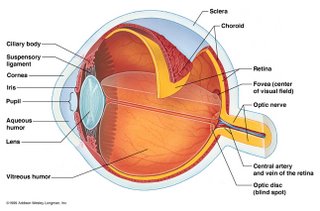
As we think about the basic parts of our eyes (Fig. 1), we observe that they consist of cornea, lens, iris, ciliary muscle, and retina connected by optic nerve to brain. Functioning of eye depends on the amount of light entering the eye (Light intensity) and focusing of the image on retina. Two independent systems control these two aspects of vision.
Let there be light:
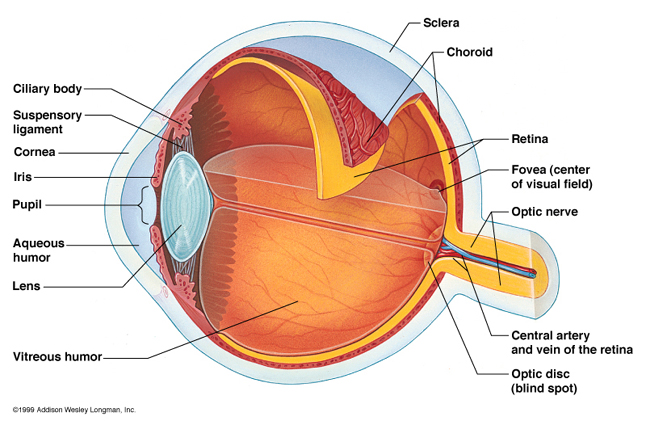
As we think about the basic parts of our eyes (Fig. 1), we observe that they consist of cornea, lens, iris, ciliary muscle, and retina connected by optic nerve to brain. Functioning of eye depends on the amount of light entering the eye (Light intensity) and focusing of the image on retina. Two independent systems control these two aspects of vision.
Firstly, amount of light is regulated by the opening of pupil which is controlled by the two muscle groups in iris. Sphincter (controlled by cranial circuit which also controls the ciliary muscles which help in focusing) and dilator muscles (controlled by symphathetic nervous system of spinal cord: I wonder whether this is the reason why people look for dilated pupils when looking for vital signs in an unconcious person). Dilator muscles causes the pupil to open more whereas sphincter muscles cause the pupil to close as they contract. Acting together they control the opening of pupil in such a way that there is always an optimum light intensity falling over retina. This is a feedback control system where the pupil opening is the controlled variable( via the sphincter and dilatory muscles) while the system output is the light intensity on retina. The input is the light intensity of the environment and the control system aims to achieve a perfect pupil opening that optimizes the light intensity on retina under varying environmental conditions. By testing the pupil opening with narrow light beams (so that they do not have an effect on the light intensity regardless of pupil opening and thus disconnecting this feedback loop) it was found that the system is a very stable low gain system. Further, it is to be noted that this is not the only way eye responds to light intensity. There is another system on retina itself which adjust the signals to the optic fiber based on light intensity (reason why we can see the outlines a little better in a dark room after a few seconds of adaptation).
For more information about eye: http://www.arn.org/docs/glicksman/eyw_041001.htm
How about a little warmth as well: Maintianing optimum body temperature is vital for survival as most of the enzyme catalyzed reactions rates depend critically on it. Temperatures of cold blooded animals follows that of its surroundings (poikilothermy; one of the reasons such animals can be found mostly in tropical and temperate regions of the world) while that of warm blooded animals is tightly regulated (of course allowing for diurnal variations based on circadian rhytms) and is known as homeothermy. However, not everything is in pure black and white as is the rule in nature. During hibernation warm blooded animals such as hedgehog, bat and dormouse become coldblooded (to conserve their energy?) and this is referred to as heterothermy.
(More info on mammalian temperature regulation here: http://animals.about.com/cs/mammals/a/aa061601a.htm and Wikipedia entry:
http://en.wikipedia.org/wiki/Body_temperature )
For more information about eye: http://www.arn.org/docs/glicksman/eyw_041001.htm
How about a little warmth as well: Maintianing optimum body temperature is vital for survival as most of the enzyme catalyzed reactions rates depend critically on it. Temperatures of cold blooded animals follows that of its surroundings (poikilothermy; one of the reasons such animals can be found mostly in tropical and temperate regions of the world) while that of warm blooded animals is tightly regulated (of course allowing for diurnal variations based on circadian rhytms) and is known as homeothermy. However, not everything is in pure black and white as is the rule in nature. During hibernation warm blooded animals such as hedgehog, bat and dormouse become coldblooded (to conserve their energy?) and this is referred to as heterothermy.
(More info on mammalian temperature regulation here: http://animals.about.com/cs/mammals/a/aa061601a.htm and Wikipedia entry:
http://en.wikipedia.org/wiki/Body_temperature )
It can be observed that for the thermoregulation system: the controlled variable is the heat producing/conserving mechanism while the output is body temperature. The input variable is the environment temperature and the temperature of the body. Now one can ask, where should be temperature be measured so that it best represents the body temperature? on the surface of the body? or closer to the internal organs? As anyone would point out, skin temperature is not the best place to estimate the body temperature, just as placing the thermometers on the outside of a building whose interior temperature has to adjusted is a bad idea. However, it is always a good idea to open/close the windows based on outside temperature while firing up the heater must be based on both outside and inside temperature. Something similar happens in our bodies too....the internal mechanism activates the heat producing/ conserving mechanism; while the case of conserving heat by closing windows regardless of inside temperature can be related to closure of sweat glands in cold weather regardless of internal temperature. This way the amount of energy expended to maintain the temperature can also be minimized. more often than not, such multiple optimization schemes are inbuilt in biological control systems.
Ref: Optimality principles in biology: Robert Rosen, Butterworths, London. 1967. [An Excellent book that deals with the issues we discussed in chapter 9]
In the next article, we hope to discuss how seemingly extremely complex branching pattern of blood circulation system can be derived from optimality arguments (again the above book has an excellent analysis).
In the next article, we hope to discuss how seemingly extremely complex branching pattern of blood circulation system can be derived from optimality arguments (again the above book has an excellent analysis).
Subscribe to:
Posts (Atom)

