It was not too long back that the whole of biology was very protein and DNA centric. The reasoning was that proteins were used to do all the work in the cell - be it chemical work (enzymes), or physical work (motors, and pumps). DNA was important because it provided all the information to make the proteins and contain the set of genetic instructions that are passed on from generation to generation. For long, there was a battle whether DNA was more important or proteins were more important neglecting DNA's chemical cousin RNA.
RNA was considered as a step required in modern organisms to convert DNA to proteins. RNA is made up of nearly the same chemical constituents as DNA but it is more flexible and can have wide ranging 3 dimensional structures unlike DNA's double helical structure. However, this increased flexibility comes at a price - RNA is more unstable and in modern cells, a single molecule of RNA does not remain functional for long periods of time (mean life time is approx 5 minutes in E.coli).
Of course, all this changed when it was found that RNA molecules could be used as catalysts and even in modern day cells, there are some RNA catalysts also called ribozymes (and the list of ribozymes discovered keeps increasing). RNA captivated the imagination of biologists as this was a molecule that could store genetic information as well as be used as catalysts - taking on the dual role of enzymes and information storage. All of a sudden, RNA was considered to be at the origin of life as we know it. However in the RNA world hypothesis, one should take into consideration that it is not that only RNA is present. It only postulates that RNA is present and is dominant but other biochemicals such as peptides (small proteins) and DNA oligomers (small DNA molecules) are also present and aiding life (idea originally proposed in [1]).
One of the biggest controversies against the RNA world hypothesis has been that it does not play that big a role in modern cells. However, it has been found more recently that there are many RNA control elements in the cell. One such control element is the riboswitch. For a gene to be made, the DNA gets converted into a message called the mRNA (messenger RNA) which later gets converted to the protein equivalent to that message. It has increasingly been found that mRNA do not contain only the message to be read but certain control elements could also be present in the mRNA. These control elements are called riboswitch.
Lets take an example. Supposing you want to make Vitamin B1. There is an intermediate in its biochemical pathway called thiamine pyrophosphate (TPP). TPP is also important for nucleotide (the chemical constituent of RNA and DNA) and amino acid (the chemical constituent of proteins) biosynthesis and is important for the cell to have the right amount of TPP channeled into the different biochemical pathways. When too much of TPP is present in the cell, TPP binds to a certain riboswitch in it's own biochemical pathway. This causes the riboswitch [2] to suddenly have a defined 3-dimensional structure (from an earlier random or semi structured RNA element). This defined 3-dimensional structure also blocks the production of the protein for making more TPP. The switch in the mRNA turns the production of the protein that makes TPP on or off depending on whether enough TPP is present in the cell or not - hence regulating the production of TPP itself. So far, riboswitches are found more in the microbial world and are only now being found in the eukaryotic world.
Now, in the latest issue of Nature, the first riboswitch that controls splicing in higher organisms such as fungus has been found [3]. Splicing is the mechanism by which parts of the mRNA are removed before the protein is made so that parts of the DNA never translated in the protein. Alternative splicing is the mechanism by which a single gene at the DNA level can be translated into multiple protein molecules. This is done by excising different parts of the mRNA (excising the DNA only in one situation and not another) before it gets converted to protein. Splicing and alternative splicing occurs only in eukaryotes and has also been discussed here.
Anyways, the first riboswitch in the mRNA have been found to function for alternative splicing purposes. The TPP biochemical pathway discussed above is the system that they found riboswitches in. In this case, when TPP was present, the riboswitch forms a three dimensional structure that avoids splicing and the protein that is formed can not make more TPP. So the objective was again control of TPP concentration in the cell but the means used was alternative splicing instead of just blocking formation of protein. The implications of these results will only come out with time, but there is speculation that this opens up a whole pandora's box on riboswitches that could be found in eukaryotes.
[1] The Genetic Code - Carl Woese, 1968.
[2] Thiamine derivatives bind messenger RNAs directly to regulate bacterial gene expression. Wade Winkler Ali Nahvi & Ronald R. Breaker. Nature 419, 952 - 956 (2002).
[3] Control of alternative RNA splicing and gene expression by eukaryotic riboswitches. Ming T. Cheah, Andreas Wachter, Narasimhan Sudarsan & Ronald R. Breaker. Nature 447:497 (2007) and its companion discussion article - Molecular biology: RNA in control. Benjamin J. Blencowe & May Khanna. 447:391 (2007)
pdf of all cited aritcles avaiable on request
Showing posts with label Genes. Show all posts
Showing posts with label Genes. Show all posts
Thursday, May 24, 2007


Friday, April 06, 2007
Heights! Mapping the "Toy" Gene
 Domesticated dogs are amazing in their variety - pocket size Yorkshire terriers to Great Danes! Ever wonder what accounts for that disparity?
Wonder no more. This week's issue of Science sees a study published that gives us a clue to how a mutation in a single locus regulates size in these creatures.
A team of more than 20 scientists from eight institutions (United States and the U.K.) toured the dog show circuit and collected blood from 3,241 canines of all sizes and shapes. They found that the reduced growth mapped to a locus, near the IGF1 gene. In human IGF1 plays a role in the growth from birth till adolescence.
In all the "toy" dogs tested (distantly related and reproductively isolated), there were mutations in the region next to IGF1. This is intriguing to see a single change map to all the small breeds, indicating that the change probably maps to the time when dogs evolved from their wolf-like ancestors. The same "small dog marker" however, is not found in the modern wolves.
Why is this so fascinating? Mostly because the entire study pinpoints a single allele to be responsible for the phenotypic variation (small size) and the result was achieved without doing a single cross!!
Monday, November 20, 2006
Fruitless Attempts To Explain Behaviour Hardwiring
About an year ago, Dickson lab had published an article about a behavioral switch gene, called Fruitless. It had gained notoriety in the popular press as the “Gay Gene” since it affects sexual orientation but to me Fruitless is interesting not only because it determines sexual orientation but more importantly as it gives a glimpse into how genes modulate behavior.
You see, behavior is “hard wired”into our nervous system during development. The neuronal body plan is already present in our genome - the developmental genes that direct cells to grow into a specific type or in a specific direction. These genes during development take cues from the environment and hard wire innate behavior in to a species. I have always thought that to be the coolest thing. Think about it - we are not only a function of our genes but also product of our environment. And Dickson's research links the two together - how a presence of a single gene product directs the function of neurons responsible for sexual orientation in fruit fly males. Courtship behaviour in D. melanogaster is invovles a series of well chorographed steps that invovle the visual, the olfactory, the tactile, the acoustic, the gustatory and the mechanosensory stimuli being exchanged between the sexes (See Fig.1). The role of the female is more simplified -she simply runs away, gives the odd kick, then mates (or not).
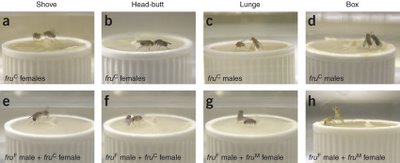 Figure 2. Aggresion Behavior in flies
You see, behavior is “hard wired”into our nervous system during development. The neuronal body plan is already present in our genome - the developmental genes that direct cells to grow into a specific type or in a specific direction. These genes during development take cues from the environment and hard wire innate behavior in to a species. I have always thought that to be the coolest thing. Think about it - we are not only a function of our genes but also product of our environment. And Dickson's research links the two together - how a presence of a single gene product directs the function of neurons responsible for sexual orientation in fruit fly males. Courtship behaviour in D. melanogaster is invovles a series of well chorographed steps that invovle the visual, the olfactory, the tactile, the acoustic, the gustatory and the mechanosensory stimuli being exchanged between the sexes (See Fig.1). The role of the female is more simplified -she simply runs away, gives the odd kick, then mates (or not).

Fig. 1 Courtship behaviour in Fruitfly
This normal courtship behaviour seems to be disrupted in the Fruitess mutants. Before we talk about what happens when we mutate this gene, lets us take a brief overview of what is known about the gene. Fruitless gene was molecularly cloned in 1996 and the putative protein encodes a transcription factor. Fruitless is sex specifically spliced - in lay man terms it means that males produce one version of this protein where as the females produce another. This sex specific splicing is regulated by presence or absence of another protein called Transformer, which in Drosophila also determines the sex in the fly.
So what happens if you produce the wrong version of the protein in either sexes? By forcing males to express the female-specific Fruitless transcript by using the awesome power of Fly genetics (:P), the Dickson Lab produced males that were sterile, uninterested in courting females, actively courting males, actually ending up forming courtship chains (see this). By contrast, females making the male version of the protein mated poorly, produced very few eggs, but — astonishingly — courted other females (see this), even to the point of forming chains.
So why does this happen? When you look at the the central nervous system of males and females ,there are very few differences in terms of sex-specific Fruitless expression- in number, position or wiring of cells that express this protein. But Fruitless is present in the olfactory sensory neurons which play an important role in fly courtship behavior. So when male fruit flies cannot produce this male specific form or produce a mutant form of this protein, you get males that court other males. In other words, a single gene encoded product is enought to shift the functioning of the nervous system from male to female mode, irrespective of the morphological sex of the animal. Simply put with mutant (rather non-sex specific)versions of the protein, flies change their sexual orientation but they not other aspects of their morphology.
Now the same gene is making a news splash again – the Kravitz lab has linked Fruitless to yet another sex-specific behavior – aggression/ fighting patterns. Aggression found in almost all animals - from sea anemones to human - helps to acquire food/shelter/ mates or defend the same. Despite its importance, relatively little is known of the neural and humoral mechanisms that are its proximate causes. Many behavioral patterns in aggressive behavior are shared in flies but there are a subset that are sex specific. Female fighting, for example, largely involves head butts and some shoving. Males show extended wing threats, wing-flicking while retreating, and high intensity components of fighting like boxing, tussling and holding. In contrast to male fighting behavior, no clear hierarchical relationship results from the interactions between female flies.
 Figure 2. Aggresion Behavior in flies
When the versions of Fruitless are swapped, the males fight like females (the sissies) and females lunge at their opponents as seen in the Figure 2 above. The top panel shows the normal aggresion patterns seen in males and females while the bottom panel shows what happens when the flies produce the wrong version of the protein. Panels e and f show males exhibiting female aggression pattern when they express the female version of the protein. When the sexes with the opppsite version of the protein are put together in the panel g and h. In panel g, the upright lunging fly is a female and so is the upright "boxing" fly in panel h , indicating that swapping the protien alters how the flies respond - another innate behaviour affected!
The question that still remains (the most important one) is what is the effector? What does Fruitless, a transcription factor, modulate in a gender specific manner to control the sex specific aspect of behaviour?
There is a lot to still uncover but we are finally beginning to glimpse at how a genes influence how we respond. I believe that most behaviour is hard wired but at the same time modulation of the behaviour is environmental dependant. And now we finally are beginning to tell the effect of nature on nurture. A fun time lies ahead in molecular neuroscience!
Reference
1 - Demir, E. & Dickson, B. J. Cell 125, 785−794 (2005).
2- Vrontou E, Nilsen, S. P., Demir, E., Kravitz, E. A. & Dickson, B. J. Nature Neuroscience - 9, 1469 - 1471 (2006)
Subscribe to:
Posts (Atom)
