Wednesday, October 25, 2006

A Splicing Primer

The central dogma of molecular biology DNA-> RNA-> Protein shows the direction of flow of information of how the cells use the information stored in our DNA to make the necessary proteins. But the situation in most eukaryotes is a little more complex than that simple statement. In most eukaryotes, a gene sequence in a DNA is interrupted by non- coding information. Hence to make a protein, a cell first has to transcribe the gene (make a RNA copy of the gene, called pre-mRNA) and then modify the pre-mRNA by removing the non-coding sequence (intron) and joining the coding sequences (exons) together. The modified mRNA is then exported from the nucleus (where it was made) to the cytoplasm where the ribosome uses it as a template to make the protein. In simple English, the gene for making a proteinA looks like this "HEREabhjhdyfrhUSEndcbldfhdfmMEd ldshhglgmcFORdbfhdflhfnmc PROTEIN A". The task of the cells is to remove the gibberish and make a readable text out of the given instruction - HERE USE ME FOR PROTEINA. The cells then send this information to the ribosome (the protein factory) to make the protein.

Pre-mRNA splicing is the process in which the intronic sequences are removed within a large RNA-protein complex called spliceosome.

Why is splicing important? A spliceosme can remove the non-coding introns present in a given transcript varying combination in response to cellular cues, a process called alternative splicing. The recent completion of a draft of the human genome indicated that more than 59% of the human genes seem to be alternatively spliced (Hastings and Krainer,2001) and thus we can have more complexity (make a larger number of proteins) without increasing the number of genes present. For eg, the Dscam gene in flies has 38,000 alternatively spliced isoforms from four variable exon clusters!
More importantly, it is estimated that aberrant splicing causes about 15% of genetic diseases in humans (Philips and Cooper,2000). Thus, the spliceosome plays a critical role in generating the right template for making a protein and any abnormality in this process would be deleterious to the organism.

What do we know about this process? From genetic and biochemical experiments in the humble budding yeast, scientist have been able to understand how this process occurs. Because both the mechanism of splicing and the splicing machinery are highly conserved throughout eukaryotes, knowledge of yeast splicing gives us insights into the basic process in humans.
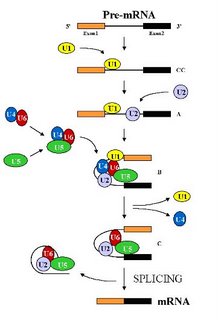
The spliceosome is the largest structure in the cell and is composed of five small nuclear RNAs ( called U1, U2, U4, U5 and U6 snRNAs) and over 100 different proteins (Stevens and Abelson , 2002). Under standard in vitro (i.e. in a test tube) assay conditions, the spliceosome assembles in a step wise manner through the addition of the U1 -> U2-> U4/U6.U5 snRNP particles (the small nuclear RNA along with its associated proteins, represented by a colored blob in the picture) on the pre-mRNA (See Figure). This assembly is an expensive process for the cell as each step consumes energy. But it also allows the apparatus to check each step and hence allows for a greater control over the overall process. Remember, a single mistake here would result in a protein that either does not function or functions abnormally. That to a cell would be hazardous and hence the cells err on the side of caution. After the assembly of the spliceosome, it undergoes structural rearrangements, resulting in the loss of U1 and U4 snRNAs, to become catalytically active (Brow D. A, 2002). Then, it proceeds to remove the intron by two transesterification reactions.

The resultant message is released from the spliceosome along with the intron. The spliced RNA is exported to the cytoplasm for translation into the protein and the intron degraded by enzymes in the cell. The spliceosome is disassembled and the components (proteins and the snRNAs) recycled for another round of splicing.

Though much is known about the overall process, there is no insights into what triggers the activation. What informs the spliceosome that everything is set in place and hence go ahead and splice? How does the cell control the ATP driven helicases that remodel the spliceosome at each step? Or what cues the cell about abnormal spliceosome and how does it take a stalled spliceosome apart?

Next time I will try and address the role splicing plays in Humans. How does a cell choose which exon to keep? How do DNA elements present in the gene (ISEs) affect choice of exon? Does the rate at which the transcript is made affect exon choice? So keep your eyes out for Splicing -part deux.

References -
Brow D. A, Annu Rev Genet., 2002, Jun 11; 36:333-60.
Hastings and Krainer, Curr Opin Cell Biol., 2001, Jun; 13(3):302-9
Philips and Cooper, Cell Mol Life Sci., 2000, Feb;57(2):235-49
Stevens and Abelson , Methods Enzymol. 2002;351:200-20.
Check this Animation

Saturday, October 14, 2006

A Beautiful Mind

"Imagine if you'd suddenly learnt that the people, the places, the moments most important to you were not gone, not dead, but worse- had never been. What kind of hell would that be?". - A Beautiful Mind, 2001.

I saw the movie for the second time last night and it got me thinking about the complex disorder that is schizophrenia, and the intense effects it has on an individual, making him lose the distinction between real and imaginary. So what is it that makes a person harbour irrational thoughts and so convinced about the his false fears? I tried to poke around the literature to try to understand how much of the organic basis for this disorder is understood. There is the genetic component- the heritable nature of this disorder has been well documented over the years. Mutations in genes that are involved in brain function can be inherited, causing offspring of schizophrenics to be that much more at risk of developing the disorder. The environment plays an equal role, stress and psychological trauma are known to have a causal or triggering effect in schizophrenia, translating genetic predisposition to development of the disorder.

The neuropathology of the disease itself is closely linked to the above described factors. Bad genes, as well as early trauma to the brain, prenatal exposure to infections and psychological trauma result in brain abnormalities that cause cognitive defects and result in the disorder. There are two aspects to understanding how impaired brain function leads to this condition. Firstly the anatomic location of neural systems that are disrupted govern the types of symptoms exhibited by a patient. Various regions of the brain are involved in different functions such as processing impulses, perceiving thoughts and producing a reaction to a stimulus. The distortion in reality observed in schizophrenics is attributed to one region of the brain, thought disorganisation involves malfunction of a different circuit, while a decline in perceptive and physical responses are traced to malfunction in yet another circuit.

Secondly, brain chemistry- in terms of fluctuations in neurotransmitters (the chemicals that transmit signals in the brain cells) control the duration of above mentioned symptoms, to add another layer of complexity to this intricate orchestration. The sum effect of all of this is disorganised thinking, delusional and paranoid thought processes and auditory hallucinations that manifest as schizophrenia.

Dopamine, glutamate and NMDA are some of the neurotransmitters that have been implicated in schizophrenia. The "Dopamine hypothesis" is particularly famous, as it was one of the first major biological causes that could be attributed to schizophrenia. However, it is now thought to be an oversimplification at understanding the disorder, since there are other factors that play a role. Nevertheless, I will discuss the hypothesis because it provides atleast some insight into the process, and is quite fascinating.

Dopamine is a neurotransmitter, and in one of it's functions it is associated with the "pleasure system" of the brain, providing feelings of enjoyment and motivating a person proactively to perform certain activities. Essentially, it mediates the conversion of an outside stimulus from being a "cold" or neutral bit of sensory information into an "attractive" or an "aversive" entity.

For example- normally an external stimulus such as a bright red sports car zipping past a pedestrian might result in a surge of dopamine to cause an appropriate reaction- like the pedestrian turning his head to look at the car. However, the reaction elicited also depends upon the the pedestrian's predispositions and experiences. A race-car enthusiast may turn to look, while a person not interested in sports cars will not exhibit any reaction. In any case, dopamine here mediates a contextually relevant reaction.

In the 1970s, it was discovered that drugs that block dopamine function reduced psychotic symptoms. Further studies led to the hypotheses that dysregulated dopamine transmission causes an abnormal release of dopamine, so that what would have been a normally neutral stimulus results in firing up of neurones and causes aberrant reactions to external objects or their internal representations. Remember Nash in the movie reacting to something as simple as his wife turning on the light by saying "Why did you turn on the lights? Why would you do that? Why?" ?

In this stage, the patient develops a sense of anxiety and confusion, and an intense need to make sense of the new "realities" being experienced. Any and every normal occurrence can produce an exaggerated response in his mind, and he keeps looking for meanings and explanations to calm himself down. As he forms delusions in his mind to explain the occurrences, he experiences a feeling of relief and reduced perplexity. These delusions then persist, even after the stimulus is taken away, eventually taking on a life of their own. Hallucinations arise from similar aberrant thought processes, as the patient conceives an incorrect internal image of a thought or a memory that is percieved and reinforced with such intensity as though it were real.

This is, like I said earlier, just one aspect of cause and development of psychoses but enough to give us a peek into the on-goings in the brain of a schizophrenic. Imbalances in other neurotransmitters and pathways have different ways of interfering with normal thought process and causing psychological disturbances. Given the limited knowledge and understanding of this disorder, how is it brought under control?

Anti-psychotics are useful in the treatment of psychoses, because, in one way, they dampen the effect of the excessive dopamine (in this example) and thus restore a chemical balance that calms the patient. However, they do not change the underlying thought process- all they can do is prevent neutral stimuli from producing abnormal reactions, and quenching aberrant reactions produced initially. Thus, patients are able to "ignore" or control their reactions to stimuli, but are not entirely free of the delusional thoughts that have already formed. This underscores the importance of staying on the drugs as long as is necessary, and also protecting the patient from high stress environments that can cause a resurgence of symptoms. Modern drugs are now being developed to limit side-effects in patients. Imaging technologies have improved to better visualise brain abnormalities associated with schizophrenia. With the availability of genome sequences and better tools, more genes are being discovered that may play a role in the disorder. Emerging tools in pharmacogenomics can make the best of these discoveries to improve treatment. Social acceptance and sensitivity towards the ailment is also needed , to create a support system that does not stigmatise patients.

John Nash's story is a very encouraging one in the face of this complex disorder. His story shows that one can be successful in bringing the disorder under control to a large extent. Eventually, Nash learns to ignore his irrational fears and focus on his passion. The same brain that gave rise to abnormal thought processes also contributed to his Nobel-prize-winning work on the game theory. Indeed, the mind is a beautiful thing!

References: 1) Wikipedia
2) Schizophrenia: challenging the orthodox McDonald et al
3) Schizophrenia in a molecular age. Carol A Tamminga

Monday, October 09, 2006

How does a digital camera work?

In the previous post, I had talked about how a digital photograph is stored in the computer. In this post, I will talk about how a digital photograph senses the photograph talking only about the essential components (using description for RGB colors). A modern digital camera has far more advances than the simplistic picture explained here.

A digital camera has a number of lenses which focus light onto chips that are sensitive to incoming light. In the market, there are two types of image sensors - charge-coupled device (CCD), and the Complementary Metal Oxide Semiconductor (CMOS). CCDs [1] are far more popular than CMOS chips because they are considered to be affected by noise to a lesser extent (and I will use CCDs to explain how a digital camera works). The role of this chip is to sense the light that comes in and convert the light energy to an electric signal that is amplified and then digitized and finally processed.

How a CCD works? Photoelectric effect [2] is the property by which some metals emit electrons when light shines on them. The CCD in the digital camera is a silicon chip that is covered with a grid of small electrodes called photosites. One photosite corresponds to each pixel.

Before a photo is taken, the camera charges the surface of each photosite with electrons. When light strikes a particular side of the photosite, the metal at that site releases some electrons, which travel to the opposite end of the site (forming what is commonly called the capacitor). The larger the intensity of the light that falls on it, the larger the number of electrons that are released, and hence larger the voltage that develops across the photosite. The voltage is then converted to a number using an analog-to-digital converter that corresponds to the intensity of the light that falls on that site. This takes care of the intensity, but we have not discussed about how the photosite knows the color of the light.

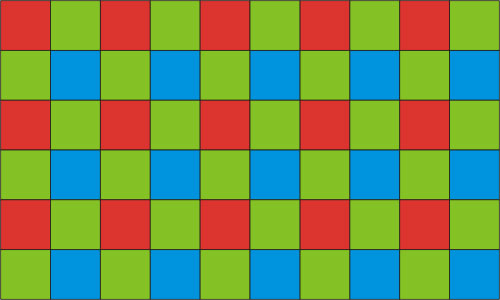
As discussed earlier, the color of a pixel is formed by mixing red, green, and blue colors (RGB). So all the light does not hit each photosite, but rather, there is a filter placed on top of the photosite that only lets red, green, or blue color through. Hence, depending on what color is through, each photosite only measures the intensity of the red, green, or blue color that falls on it, and no other color. After this, to measure the intensity of green and blue colors on a site with a red filter, an interpolation algorithm (a process called demosaicing) is used that approximates the intensity of the blue and green light on that site using the intensity of these colors in the neighboring sites.

Lastly, as green is in the center of the spectrum in the visible light (VIBGYOR), our eye is better at picking up different shades of green, and hence, there are a larger number of photosites that sense green light than blue or red. The Bayer pattern shown below is the most common arrangement of photosites in a single array CCD chip.


The other end of expensive digital cameras (read 10's of thousands of dollars) have multiple arrays and avoid the interpolation step. So the incoming light could be split into three copies and then passed through three separate filters and three different arrays and sensed separately to make the final picture by merging these readings together.

There are more complications that arise even in the simple camera, but maybe another post to deal with them (but no promises as I got to do some research before I can post myself).

[1] CCDs were invented by George Smith and Willard Boyle at the Bell Labs.
[2] Albert Einstein won the Nobel prize in 1921 for the quantum explanation of photoelectric effect.

Source:
The source for most of this stuff is Chapter 2 of the Third Edition of the Complete Digital Photography by Ben Long, though the mistakes here are probably mine.

For further reading:

How Stuff Works answers how a camera works
How an image sensor works?
CCD vs CMOS
Wikipedia's CCD entry

Friday, September 29, 2006

How is a digital photo stored?

Just as the word digital suggests, a digital camera digitizes every image that it captures. What this means is that a typical rectangular photo is divided into a large number of squares which form the basic picture element called the pixel. Within a given pixel, the color of the image does not change. In the simple case where the pixel can either be black or white, the state of the pixel can be binary - either 0 (white) or 1 (black). The state of each pixel is stored at each location and when all the pixels are put together, you get your image back. Hence, the image is said to be digitized now.

In the real world, most pictures are stored either in color or in various layers of grey scale. For example, when each pixel element is stored as 8 bits, the number of states would be 256 - a number from 0 to 255. 0 represents white, 1 to 254 represents various scales of grey in increasing intensity, and 255 represents black. So when a color photo taken with a digital camera is converted to black and white, the correct term is actually a grey scale photo, because it has varying levels of black and white.

In color photographs, each pixel is made by combining various levels of primary colors. When an artist mixes colors with paints, he combines 2 colors to make a 3rd color. The primary colors are the colors which can combine to make all the colors required in a digital camera. In a typical camera, the primary colors used are Red, Green, and Blue (forming the RGB colors). Another set of primary colors used often are Cyan, Magenta, Yellow, and the Black (called the CMYK colors). Each color set has it's own advantages as it can capture a certain range of colors well. The rest of the post will be based on a RGB photo though it will equally apply to CMYK or any color set.

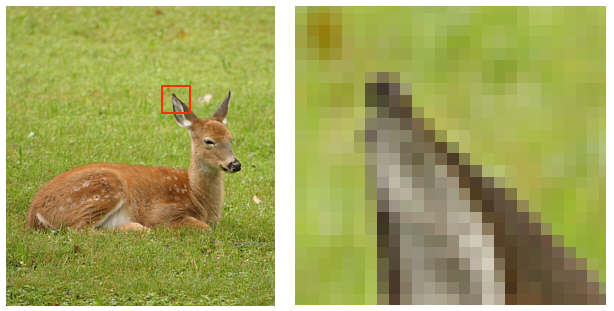
In the case of a RGB photo, each pixel uses up three storage units (for each color) of certain bit size associated with it. In the case of the 8-bit size storage unit, each pixel will have one storage unit each for intensity of red color (numbers 0 to 255 signifying varying levels of red color similar to the grey scale pictures discussed above), green color, and blue color. The various levels of red, green, and blue colors are mixed to form the actual color of that pixel. A picture stored in this manner would be 24-bit picture because each pixel would be stored in a 24-bit memory unit. The fact that the color of a pixel does not vary can be seen when you blow a picture beyond 100%. When the picture on the left is blown up to look at each pixel, the picture will look as the one on the right:


(Picture courtesy http://photo.net/equipment/digital/basics/)


The larger the resolution of the picture, the larger the number of pixels per inch (PPI). If one were to print a photo on paper, the resolution should be greater than 200 PPI on each side of the rectangle. A 3 MP camera can hence be used to print out photos of the 4" * 6" prints. The greater the resolution of the camera, the larger the size of the photo that can be printed out from it.

I will follow this post with a post on how the digital camera senses each photograph.

To get more information on this:
Photo.net's tutorial
Cambridge's tutorial

Wednesday, September 27, 2006

Living in a distributed world

In this post I had mentioned how ants work together to find a short way past obstacles, and said that they are not the only living things that work in that way. Engineers, though, have a different way of looking at it than pure scientists. These types of systems are called Distributed Control Systems, meaning that there is no central controlling authority, but instead, each individual follows a set of simple rules and this alone is enough to achieve the system's objectives.

Such a concept may seem alien at first. We humans are used to a hierarchical system of getting things done... in governing citizens, in managing corporations, in controlling manufacturing systems, in practically everything, we have a system of smaller parts reporting to progressively larger parts. But there is evidence to show that simple rules followed by a large number of peers can lead to as complicated a global behaviour as might be required.

I'm going to take an example of a non-living thing this time. The following experiment is called Conway's Game of Life. Consider a two dimensional matrix, in which each cell can have a state of "dead" or "alive". Each cell has eight neighbours; if zero or one of them are alive, the cell dies of loneliness. If two or three neighbours are alive, the cell lives. If four or more neighbours are alive, the cell dies of overpopulation. A dead cell "comes to life" if it has exactly three live neighbours.

Depending upon the initial state, an astounding variety of beautiful and complex patterns have been observed to arise out of these simple rules, including different types of oscillators, explosions, firing guns, even moving spaceships!

A snapshot of the Game of Life Applet: From http://www.ibiblio.org/lifepatterns/

While I used this only to demonstrate that simple rules can result in complex, self-organizing behaviour in a distributed world, the fact remains that a lot of the "management" in nature occurs this way. It doesn't take an engineer to understand the problems with centralized control in a large hierarchy; if you've tried getting something past the bureaucracy of your university, workplace or government, you know it all too well yourself! But engineers understand how difficult it is to design a distributed control system. It is only in extreme circumstances that they do indeed deploy systems in such a manner - for example, in large sensor networks, where thousands of sensor nodes may be released in forests, underwater, anywhere!

We live in a distributed world, in which the sum of parts is inevitably greater than the whole. Sometimes we scientists get a glimpse of it in our computer simulations, but you only need to look out of your window to understand. When you see a flock of birds flying in formation. When you see a beehive. And once you truly understand it, you will see the world through brand new eyes.

Monday, September 25, 2006

X Chromosome Inactivation


That cute kitten is Copycat or CC – the first cloned cat. She is genetically identical to her “mom” (to the right) but phenotypically different. The reason is because of the peculiar phenomenon called X-chromosome inactivation (XCI) that occurs in all the female cells in mammals.
In mammals sex is determined by differential inheritance of the sex chromosomes. Females are XX while males are XY. To compensate for having an extra dosage of X chromosome genes that might be developmentally fatal, the cells in the female embryo randomly select one X chromosome and shut it off (transcriptionally silence it). This “silent” state is maintained throughout life in the female cell. Since the phenomenon is random (each cell independently decides its fate), mammalian females are essentially mosaics. CC is different from her progenitor because the gene for coat color lies on the X chromosome and is randomly silenced in the clone, giving it it’s unique calico pattern.
The phenomenon is evolutionarily conserved in the mammalian lineage – since there is preliminary evidence to suggest that XCI occurs in Prototherians (egg laying mammals) who arose 200-300 million years ago and also in Metatherains (marsupials). Since X and Y differentiation also occurs in these lineages, it is likely that XCI arose as a way of dosage compensation.
How is it done? The random X chromosome inactivation has been linked to a region on the X chromosome, called Xic (X- inactivation center). What is so unique about this region is that all the genes characterized so far are non- coding genes – they make the RNA but this RNA is never used to make a cellular protein. The ncRNA (non coding RNA) from this region are responsible for counting the number of X chromosomes present in the cell, marking one for silencing and maintaining the silenced state. The most talked about transcript from this region is Xist which is essential for the silencing step.
The mechanism of how the ncRNA form Xist or other mapped locus do the inactivation is not yet known. It is most likely that transcription of these genes help to bring in chromatin remodeling factors (things that signal that the chromosome is silenced). Since Xist transcription would take about 30 minutes, during which the RNA is physically attached to the X chromosome, this explanation seems plausible. The unraveling of the mechanism would help us understand another dosage compensation mechanism (that of imprinting) but that is another blog.

Saturday, September 23, 2006

Learning from the humble ant

The next time you're outdoors and you see a trail of marching ants, try a little experiment. Place an obstruction asymmetrically in their path, which is steep enough that they can't climb over it, and see what happens. At first, they would spread out equally in both directions to rejoin the trail. Over a period of time, you'll see the longer trail thin out and disappear as all the ants start taking the shorter trail.

What's really remarkable about this is that ants cannot see and cannot talk. That is to say, they lack the sensory organs for sight and sound. So how do they do this job of finding a short route around obstacles to their target food source?

The secret, as with many other things observed in nature, is elegant in its simplicity and inventiveness. Ants have a very good sense of smell, and lay out a class of chemicals called Pheromones to mark their trail. Each ant lays out roughly the same amount of pheromone for a particular food source, and the pheromone evaporates at a constant rate. When an ant moves towards a marked food source, it tends to move in a direction in which it senses a relatively higher concentration of pheromone.

That's all. If you're puzzled as to why I cut the explanation short, take a minute to think about how this would work and then read on. Now, when the obstacle is placed in the path, the ants can no longer sense the correct direction to travel, and they choose at random among the available directions. Ultimately, they would rejoin the trail, but each ant has now laid pheromone along the path it has taken. Initially, there is little to choose from between the two options, but over a period of time, the shorter path, simply by virtue of being shorter, would have a greater number of ants traversing the path back and forth. This means that the evaporating pheromone on the shorter route gets regenerated more often than on the longer route, causing more ants to choose that direction over the other. This further increases the disparity in pheromone level between the two choices, until there is insufficient pheromone on the longer trail to tempt even a single ant to go in that direction.

This kind of a process is called Auto-Catalytic, meaning it speeds itself up. Some time around 1990, an Italian scientist called Marco Dorigo got a brainwave on how to use this ant behaviour to solve combinatorial optimization problems, which are notoriously difficult to solve with conventional mathematical techniques.

What he did was to represent an optimization problem as a set of obstacles in the path of an ant trail. The decision of which direction to take at an obstacle represented the decision of what value to assign to a variable. In other words, if a variable can take four different values, it is like placing an obstacle giving an ant four different paths around it. Each variable in the problem is equivalent to an obstacle on the trail. "Pheromone concentrations" are maintained virtually for each decision at each obstacle.

The generation of a solution is done randomly, with the probability of taking a particular decision being proportional to the virtual pheromone concentration. Then, the "goodness" of the solution is quantified by the objective function, and this is analogous to the distance traveled to reach the food source by that route. If it is a poor solution, it is a long route and the pheromone concentrations along that route are increased by a small value. If it is a good solution, the pheromone concentrations are increased by a higher value; and all the time, pheromone is "evaporated" at a constant rate at every decision point.

It worked. In a way similar to how ants find paths, an algorithm known as Ant Colony Optimization (ACO) was developed and refined, and although it does not always find the globally best solution, it tends to find a good solution for even large problems in reasonably quick time.

In spite of all the nature-defying technological marvels scientists and engineers come up with, there seems to be an infinite depth to the workings of nature from which we learn continually. The ant optimization algorithm is but one in a wide class of algorithms under the banner of Swarm Intelligence, for ants, bees, birds and many other social denizens of nature have unique and innovative ways of doing a plethora of tasks. Computer scientists observe, and come up with smarter algorithms. Engineers observe, and come up with better control system schemes.

How wrong we are, in talking about "humble ants". It's we who are the "humble scientists".

Links for further reading:
Marco Dorigo's page on the behaviour of real ants that inspired ACO
Wikipedia
Marco Dorigo's landmark paper on Ant Systems