Many people have wrote that there is no such thing as altruism. I must admit that I have also always thought the same thing..even though I continued to search for one such act. I have often been the lone arguer pointing out that no one has been able to uncover a single example of true altruism...in a natural setting or in the human race. I am now rescinding my previous statement. I have for a very long time..searched for an example that I could in some way attribute to altruism..and until now I have been unsuccessful. I suppose all examples are based upon your own definition of altruism. I learned many years ago that altruism is an act done by an individual at a cost..benefiting another individual not of relation to the one performing the act.
The said example concerns a chimpanzee and a human. A researcher was following a group of chimpanzees in the jungle. After some hours, he found that he had forgotten his lunch back at the research station. This researcher then proceeded to try to knock down fruit from a tree some distance from where the group of chimpanzees sat eating their mid-day meal. It has been noted that after some time of unsuccessful attempts to acquire fruit... a young male from the group collected some fruits from a tree and climbed down toward the researcher. The chimpanzee then proceeded to approach the researcher and leave the fruit for the researcher.
This instance has been noted as a true act of altruism by any definition since the chimpanzee was not of relation to the researcher (not in the last 1000 years at least) and this act was a cost to itself with no benefit. Therefore, I stand corrected on the notion of altruism...it seems to exist after all.
References
Compassion, Rescue and the Altruism Debate, The emotional lives of animals Jeffrey Moussaieff Masson and Susan McCarthy.
Saturday, December 23, 2006


Tuesday, December 19, 2006
Why We Should Always Question..

There are many moments in time that we look back at now...which will always lead to us to slap our foreheads and say, "stupid, stupid, stupid". There is one such moment that continues to be brought up in the most general science classes..as if to say.."if you don't test and retest...we will ridicule you for years to come". This example is of course the lemming. Lemmings were believed to commit, "The Lemming Suicide Plunge" when the population became too numerous. It was really believed that millions of lemmings would be overcome by a hard-wired impulse to dash to their death by hurling themselves over a cliff to the rocks below or by plunging into the sea to die a horrible death by drowning. The reasoning behind this was thought to be a deep-rooted act of altruistic behavior resulting the greater good for the species. However, you can probably guess, this is not the case. Shown to the right is a famous Far Side cartoon dipicting natural selection in action. As the lemmings dash to their death..there is one cheater in the group that will survive and ultimately passing on the cheater genes to future generations.
How this story may have gotten started....
Many rodent species experience very strange cyclic population explosions. It is very interesting that lemmings have one of the most regular cyclic fluctuations in population densities. It has been shown that these little creatures have population explosions about every three or four years. The population numbers of lemmings explode to high numbers, and then drop almost to extinction. Even after approximately 75 years of intense research, scientists do not fully understand why the populations fluctuate so much. Throughout the years, many factors have been tested (i.e., changes in food availability, climate, density of predators, stress of overcrowding, infectious diseases, snow conditions, sunspots, etc) but none completely explain why populations of lemmings have these explosive cycles.
The myth of the lemming most likely started when these population explosions happen and the lemmings migrate away from areas with a dense population. As you can imagine, the migrations begin slowly and erratically. It has been shown that small numbers of lemmings will move at night, and larger groups in the daytime. This movement causes small groupings of lemmings to move instead of one continous mass, usually seperated by a short time frame of 10 minutes or so. It has been noted that they will often follow well worn paths and roads along their journey.
As you can imagine, there will be unavoidable obstacles, such as streams and lakes inevitalby causing them to swim as a last resort. Suprisingly, they are able to swim across a 200 meter body of water on a calm night, but most will drown in a windy night.
So why the myth began....
It is due to a very unlikely source....Walt Disney. Walt Disney was making a movie tittled, "Wild Wilderness" which was released in 1958. It was filmed in Alberta, Canada, in a location that is far from the sea and not a native home to lemmings. The lemming were imported and forced to jump to thier deaths by placing them on a spinning turntable that was covered with snow, and then shooting it from many different angles. The cliff-death-plunge sequence was done by herding the lemmings over a small cliff into a river. It's easy to understand why the filmmakers did this - wild animals are notoriously uncooperative, and a migration-of-doom followed by a cliff-of-death sequence is far more dramatic to show than the lemmings' self-implemented population-density management plan.
The moral of the story....lemmings do not commit mass suicide and Walt Disney has clear prejudice against the lemming and for the mouse.
Wednesday, December 13, 2006
Net Picks
Something to read while taking a break -
Fifty Years With Double Stranded RNA
Alexander Rich, the scientist who discovered hybridization and the "other" double helix describes what it meant to biology.
Bioengineering and AIDS
University of Utah scientists designed a "molecular condom" women could use daily to prevent AIDS by vaginally inserting a liquid that would turn into a gel-like coating and then, when exposed to semen, return to liquid form and release an antiviral drug.
Genetic Map Offers New Tool For Malaria Research
In one of three genomic studies of malaria appearing in Nature Genetics, scientists chart genetic variation across the genome of the malaria parasite, unlocking novel DNA regions associated with drug resistance.
Laugh And The Whole World Laughs With You: Why The Brain Just Can't Help Itself
Researchers at UCL (University College London) and Imperial College London have shown that positive sounds trigger a response in the listener's brain in an area that is activated by smile, as though preparing our facial muscles to laugh.
This Holiday Season drink without fear.
A study performed by the Research Laboratories of the Catholic University of Campobasso (Italy) confirms the beneficial effects that moderate consumption of alcohol has on our health: drinking in moderation reduces all-cause mortality.
Another reason why the Octopus Rules - in built 3-D light reflectors!
Roger Hanlon at the Marine Biological Laboratory, Woods Hole, Massachusetts and colleagues took a close look at the octopus's skin and identified a new group of proteins (leucophores) with remarkable properties.
New Insights Into The Origin Of Life On Earth
In an advance toward understanding the origin of life on Earth, scientists have shown that parts of the Krebs cycle can run in reverse, producing biomolecules that could jump-start life with only sunlight and a mineral present in the primordial oceans.
Wednesday, December 06, 2006
Science Daily Picks
Found : Apple Gene for Red
CSIRO scientist have found the gene that controls the color of apples. The red color of apple skin is result of anthocyanins (responsible for blue or red color in plants). It was known that color of apples is affected by light (less light results in poor color), so the scientist looked for genes that were activated by light and compared these to genes in a green apple and bingo!
Learning During Sleep?
Max Planck Institute for Medical Research in Heidelberg have taken a step towards understanding communication between memory areas. Their study shows a link between sleep and memory consolidation (transfer of memory from hippocampus to the cerebral cortex).
Cities Change The Songs Of Birds Leiden University researchers studied the songs of the great tit (Parus major), a successful urban dweller in the center of ten major European cities and compared the songs to that of the bird living in nearby forest sites. The results show that songs that are important for mate selection or territory defense are shorter, sung faster and at a higher pitch by the urban bird. The findings published on Dec.5 in Current Biology show divergence within a species because of the environment and could very well lead to speciation.
NASA Telescope Sees Black Hole Munch On A Star.
NASA’s Galaxy Evolution Explorer has caught a black hole eating a star, from the initial capture to the last bites.
Water Still Flows In Brief Spurts On Mars, NASA Images Suggest
NASA photographs have revealed bright new deposits seen in two gullies on Mars that suggest water carried sediment through them sometime during the past seven years.
So let the hunt for the ETs begin :)
Monday, November 20, 2006
Fruitless Attempts To Explain Behaviour Hardwiring
About an year ago, Dickson lab had published an article about a behavioral switch gene, called Fruitless. It had gained notoriety in the popular press as the “Gay Gene” since it affects sexual orientation but to me Fruitless is interesting not only because it determines sexual orientation but more importantly as it gives a glimpse into how genes modulate behavior.
You see, behavior is “hard wired”into our nervous system during development. The neuronal body plan is already present in our genome - the developmental genes that direct cells to grow into a specific type or in a specific direction. These genes during development take cues from the environment and hard wire innate behavior in to a species. I have always thought that to be the coolest thing. Think about it - we are not only a function of our genes but also product of our environment. And Dickson's research links the two together - how a presence of a single gene product directs the function of neurons responsible for sexual orientation in fruit fly males. Courtship behaviour in D. melanogaster is invovles a series of well chorographed steps that invovle the visual, the olfactory, the tactile, the acoustic, the gustatory and the mechanosensory stimuli being exchanged between the sexes (See Fig.1). The role of the female is more simplified -she simply runs away, gives the odd kick, then mates (or not).
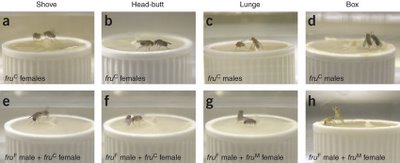 Figure 2. Aggresion Behavior in flies
You see, behavior is “hard wired”into our nervous system during development. The neuronal body plan is already present in our genome - the developmental genes that direct cells to grow into a specific type or in a specific direction. These genes during development take cues from the environment and hard wire innate behavior in to a species. I have always thought that to be the coolest thing. Think about it - we are not only a function of our genes but also product of our environment. And Dickson's research links the two together - how a presence of a single gene product directs the function of neurons responsible for sexual orientation in fruit fly males. Courtship behaviour in D. melanogaster is invovles a series of well chorographed steps that invovle the visual, the olfactory, the tactile, the acoustic, the gustatory and the mechanosensory stimuli being exchanged between the sexes (See Fig.1). The role of the female is more simplified -she simply runs away, gives the odd kick, then mates (or not).

Fig. 1 Courtship behaviour in Fruitfly
This normal courtship behaviour seems to be disrupted in the Fruitess mutants. Before we talk about what happens when we mutate this gene, lets us take a brief overview of what is known about the gene. Fruitless gene was molecularly cloned in 1996 and the putative protein encodes a transcription factor. Fruitless is sex specifically spliced - in lay man terms it means that males produce one version of this protein where as the females produce another. This sex specific splicing is regulated by presence or absence of another protein called Transformer, which in Drosophila also determines the sex in the fly.
So what happens if you produce the wrong version of the protein in either sexes? By forcing males to express the female-specific Fruitless transcript by using the awesome power of Fly genetics (:P), the Dickson Lab produced males that were sterile, uninterested in courting females, actively courting males, actually ending up forming courtship chains (see this). By contrast, females making the male version of the protein mated poorly, produced very few eggs, but — astonishingly — courted other females (see this), even to the point of forming chains.
So why does this happen? When you look at the the central nervous system of males and females ,there are very few differences in terms of sex-specific Fruitless expression- in number, position or wiring of cells that express this protein. But Fruitless is present in the olfactory sensory neurons which play an important role in fly courtship behavior. So when male fruit flies cannot produce this male specific form or produce a mutant form of this protein, you get males that court other males. In other words, a single gene encoded product is enought to shift the functioning of the nervous system from male to female mode, irrespective of the morphological sex of the animal. Simply put with mutant (rather non-sex specific)versions of the protein, flies change their sexual orientation but they not other aspects of their morphology.
Now the same gene is making a news splash again – the Kravitz lab has linked Fruitless to yet another sex-specific behavior – aggression/ fighting patterns. Aggression found in almost all animals - from sea anemones to human - helps to acquire food/shelter/ mates or defend the same. Despite its importance, relatively little is known of the neural and humoral mechanisms that are its proximate causes. Many behavioral patterns in aggressive behavior are shared in flies but there are a subset that are sex specific. Female fighting, for example, largely involves head butts and some shoving. Males show extended wing threats, wing-flicking while retreating, and high intensity components of fighting like boxing, tussling and holding. In contrast to male fighting behavior, no clear hierarchical relationship results from the interactions between female flies.
 Figure 2. Aggresion Behavior in flies
When the versions of Fruitless are swapped, the males fight like females (the sissies) and females lunge at their opponents as seen in the Figure 2 above. The top panel shows the normal aggresion patterns seen in males and females while the bottom panel shows what happens when the flies produce the wrong version of the protein. Panels e and f show males exhibiting female aggression pattern when they express the female version of the protein. When the sexes with the opppsite version of the protein are put together in the panel g and h. In panel g, the upright lunging fly is a female and so is the upright "boxing" fly in panel h , indicating that swapping the protien alters how the flies respond - another innate behaviour affected!
The question that still remains (the most important one) is what is the effector? What does Fruitless, a transcription factor, modulate in a gender specific manner to control the sex specific aspect of behaviour?
There is a lot to still uncover but we are finally beginning to glimpse at how a genes influence how we respond. I believe that most behaviour is hard wired but at the same time modulation of the behaviour is environmental dependant. And now we finally are beginning to tell the effect of nature on nurture. A fun time lies ahead in molecular neuroscience!
Reference
1 - Demir, E. & Dickson, B. J. Cell 125, 785−794 (2005).
2- Vrontou E, Nilsen, S. P., Demir, E., Kravitz, E. A. & Dickson, B. J. Nature Neuroscience - 9, 1469 - 1471 (2006)
Sunday, November 19, 2006
Exploiting the parasites to our advantage
In a recent paper (Oct 20, 2006) in the journal Science, scientists have reported the use of a parasite-specific machinery in to correct certain deficiencies in human cells, which can be then used to tackle critical genetic disorders in humans.
This is cool for several reasons: taking lessons from a one-celled parasite to apply and solve complex genetic disorders in humans is cool by itself. What made me more happy is that the paper is from a group of scientists at the Indian Institute of Chemical Biology, Calcutta, India. One of the few (AFAIK, one of the first this year) all-indian authored papers from an Indian lab in the very prestigious journal Science. (Atleast in the field of molecular biology/diseases).
Eukaryotic cells are divided into compartments: the nucleus of the cell contains the genetic blueprint of the organism (instructions coded in DNA) and is responsible for it's maintenance, expression and regulation amongst other functions. The mitochondrion, known as the "power-house" of the cell, is where energy is produced from macromolecules through a series of biochemical reactions. The mitochondria possess their own set of genetic instructions (mtDNA) which store some mitochondria-specific instructions. Mutations in the mtDNA lead to some serious disorders given that the mitochondria are the energy-centres of the cell. One such syndrome is the Kearns-Sayre syndrome (KSS) : a nervous system disorder characterized in humans by hearing loss, difficulty in swallowing, loss of muscle co-ordination and cardiac function. KSS is caused by a large deletion in the mitochondrial DNA which disrupts mitochondrial function due to loss of the information encoded in that portion.
Fixing defects in mtDNA is challenging. The mitochondria are a double-membrane enclosed compartment; delivery of material to reach the mitochondrion and get incorporated is not trivial.
This is where scientists decided to take a leaf out of the book of the protist parasite Leishmania. Leishmania is a Trypanosomatid protist parasite that is transmitted by some species of the sandfly and causes leishmaniasis ( kala azar) that is endemic to several tropical and sub-tropical countries. This group of critters are characterized by some very divergent pathways in terms of their genetic organisation. One of these includes the fact that their mitochondrial genomes do not encode any tRNA genes. (tRNA refers to a set of genes involved in the making of proteins). As a result, the entire set of tRNA genes needs to be imported from the cytosol, for which these parasites have evolved a highly specialized machinery. The transport of tRNAs from the nucleus to the mitochondria is brought about by the RIC complex (RNA Import Complex) : a mulit-subunit complex found in the inner membrane of the leishmania mitochondria. The first significant accomplishment by Adhya and colleagues was to isolate this complex and purify it. Next. they show that Leishmania RIC is capable of transporting human tRNA molecules. Then, in a series of elegant experiments described in the science paper, they went on to test if human cells are capable of taking up leishmania RIC and using it to transport tRNA molecules to the mitochondria. They incubated a variety of human cell-cultures (including cells from patients of mitochondrial disorders) with Leishmania RIC and showed that RIC was successfully localized to the mitochondria of humans. Furthermore, they showed that the defective human cells were capable of transporting a specific tRNA molecule after incorporating the RIC, which they were unable to do earlier. Thus, RIC was capable of restoring defective human cells with the required mitochondrial function, showing great promise to reverse the effects of the inherited disorder. This has great therapeutic value in correcting several defects caused by various mitochondrial mutations which are hard to reach and correct otherwise.
Think about the myriad of distances travelled here: they have crossed millions of years on an evolutionary time scale to bring a mechanism from a one-celled critter to a multicellular human system. Then, at the cellular level, crossing multiple membranes and barriers to transport molecules to the right destination. Simply fascinating!
Ref: Mahata et al, Science 20 Oct 2006 vol. 314, pp 471-474.
Sunday, November 12, 2006
Biological control systems: (attempts in) Understanding the Nature's way
For anyone who has watched the evening twilight, dark clouds and the flock of wild geese fly across the sky, it is not difficult to figure out the relative motion among the birds and among the clouds...even from a moving vehicle. This may seem to be such a simple everyday experience that few really think twice about it, but this is considered one of the toughest problems in image processing. Posed in a more scientific terms, the problem is how can you distinguish the relative motion between two frames in a noisy environment? Any one who has fiddled with an SLR knows how difficult it is to get a perfect picture under varying environmental conditions. A slight tremor in hand can ruin a picture. However, our eyes do it without much concious effort in part due to the excellent in built control system that exactly regulates the amount of light entering the eye and focuses the image on retina. Other aspect of the built in control system is that it corrects for the movement of the head with an interface to the vestibular organ in the ear. Such fascinating control systems are part of every biological system governing almost every aspect of life...Respiration control, blood pressure and thermo regulation, circadian rhytms, chemical reaction in cells and many more. In this article we will discuss about the light regulation system in eye and a little bit about thermo regulation.
Let there be light: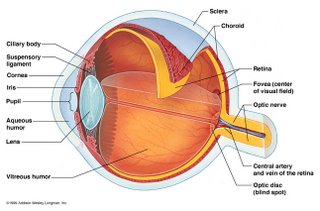
As we think about the basic parts of our eyes (Fig. 1), we observe that they consist of cornea, lens, iris, ciliary muscle, and retina connected by optic nerve to brain. Functioning of eye depends on the amount of light entering the eye (Light intensity) and focusing of the image on retina. Two independent systems control these two aspects of vision.
Let there be light:
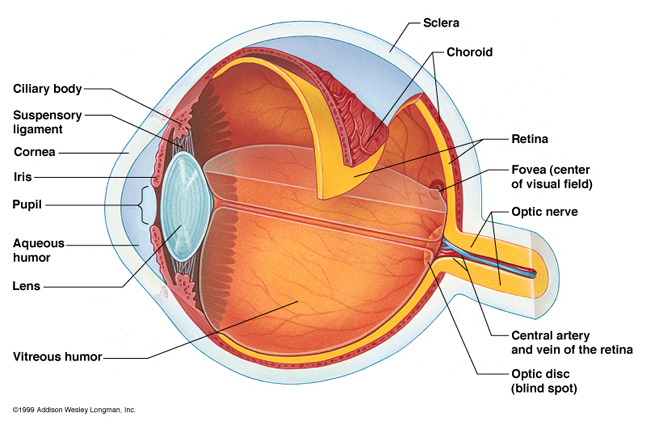
As we think about the basic parts of our eyes (Fig. 1), we observe that they consist of cornea, lens, iris, ciliary muscle, and retina connected by optic nerve to brain. Functioning of eye depends on the amount of light entering the eye (Light intensity) and focusing of the image on retina. Two independent systems control these two aspects of vision.
Firstly, amount of light is regulated by the opening of pupil which is controlled by the two muscle groups in iris. Sphincter (controlled by cranial circuit which also controls the ciliary muscles which help in focusing) and dilator muscles (controlled by symphathetic nervous system of spinal cord: I wonder whether this is the reason why people look for dilated pupils when looking for vital signs in an unconcious person). Dilator muscles causes the pupil to open more whereas sphincter muscles cause the pupil to close as they contract. Acting together they control the opening of pupil in such a way that there is always an optimum light intensity falling over retina. This is a feedback control system where the pupil opening is the controlled variable( via the sphincter and dilatory muscles) while the system output is the light intensity on retina. The input is the light intensity of the environment and the control system aims to achieve a perfect pupil opening that optimizes the light intensity on retina under varying environmental conditions. By testing the pupil opening with narrow light beams (so that they do not have an effect on the light intensity regardless of pupil opening and thus disconnecting this feedback loop) it was found that the system is a very stable low gain system. Further, it is to be noted that this is not the only way eye responds to light intensity. There is another system on retina itself which adjust the signals to the optic fiber based on light intensity (reason why we can see the outlines a little better in a dark room after a few seconds of adaptation).
For more information about eye: http://www.arn.org/docs/glicksman/eyw_041001.htm
How about a little warmth as well: Maintianing optimum body temperature is vital for survival as most of the enzyme catalyzed reactions rates depend critically on it. Temperatures of cold blooded animals follows that of its surroundings (poikilothermy; one of the reasons such animals can be found mostly in tropical and temperate regions of the world) while that of warm blooded animals is tightly regulated (of course allowing for diurnal variations based on circadian rhytms) and is known as homeothermy. However, not everything is in pure black and white as is the rule in nature. During hibernation warm blooded animals such as hedgehog, bat and dormouse become coldblooded (to conserve their energy?) and this is referred to as heterothermy.
(More info on mammalian temperature regulation here: http://animals.about.com/cs/mammals/a/aa061601a.htm and Wikipedia entry:
http://en.wikipedia.org/wiki/Body_temperature )
It can be observed that for the thermoregulation system: the controlled variable is the heat producing/conserving mechanism while the output is body temperature. The input variable is the environment temperature and the temperature of the body. Now one can ask, where should be temperature be measured so that it best represents the body temperature? on the surface of the body? or closer to the internal organs? As anyone would point out, skin temperature is not the best place to estimate the body temperature, just as placing the thermometers on the outside of a building whose interior temperature has to adjusted is a bad idea. However, it is always a good idea to open/close the windows based on outside temperature while firing up the heater must be based on both outside and inside temperature. Something similar happens in our bodies too....the internal mechanism activates the heat producing/ conserving mechanism; while the case of conserving heat by closing windows regardless of inside temperature can be related to closure of sweat glands in cold weather regardless of internal temperature. This way the amount of energy expended to maintain the temperature can also be minimized. more often than not, such multiple optimization schemes are inbuilt in biological control systems.
Ref: Optimality principles in biology: Robert Rosen, Butterworths, London. 1967. [An Excellent book that deals with the issues we discussed in chapter 9]
In the next article, we hope to discuss how seemingly extremely complex branching pattern of blood circulation system can be derived from optimality arguments (again the above book has an excellent analysis).
In the next article, we hope to discuss how seemingly extremely complex branching pattern of blood circulation system can be derived from optimality arguments (again the above book has an excellent analysis).
Subscribe to:
Posts (Atom)

